
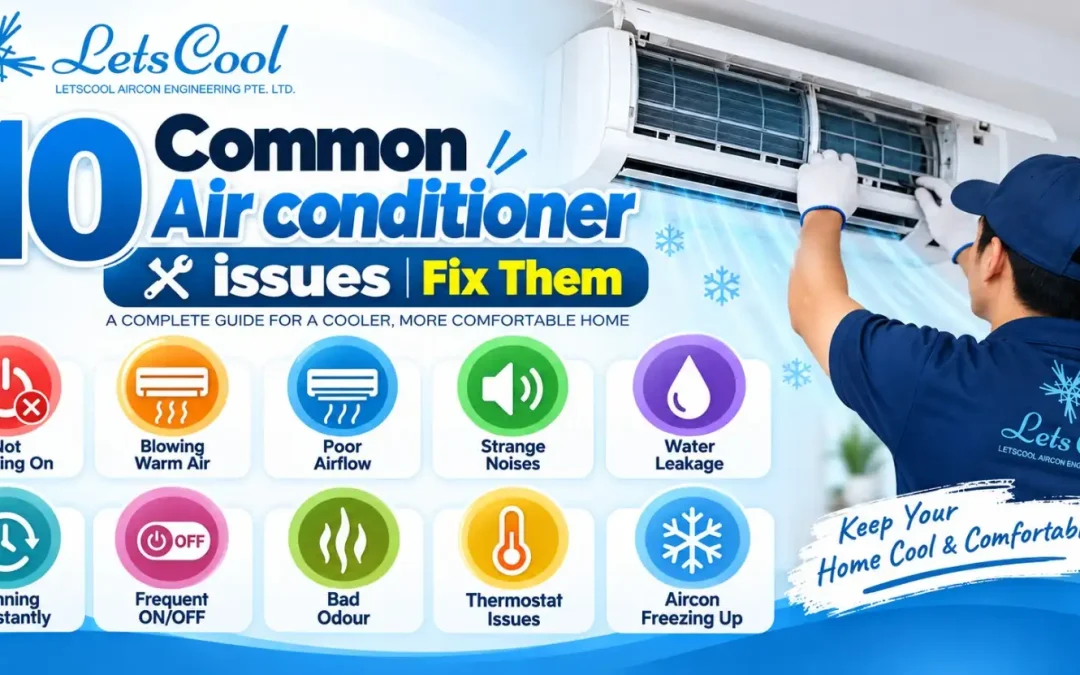
Living in Singapore means your aircon is running almost year-round. That constant usage means wear and tear is inevitable. Whether you live in an HDB flat, a condo, or run a commercial space, dealing with an aircon that isn’t cold or is leaking water can be incredibly frustrating.
While some issues require a professional Aircon Repair Service (link to repair page), many common aircon problems can be solved with a few simple troubleshooting steps. Drawing from our 25+ years of experience at Letscool Aircon, here are the 10 most common air conditioner issues in Singapore and exactly how to fix them.
1. Aircon Leaking Water (Indoor Unit)
This is the number one issue we see in HDBs and condos. If water is dripping from your indoor fancoil unit down your wall, it’s usually a drainage issue, not a gas leak.
- The Main Causes: A clogged condensate drainage pipe (often blocked by dirt, algae, or “aircon jelly”), a dirty evaporator coil, or a poorly installed unit that lacks proper tilt for gravity drainage.
- How to Fix It Yourself: Turn off the unit immediately to prevent water damage to your flooring. Open the front cover and check if the drainage tray is overflowing. You can try carefully vacuuming the end of the drainage pipe (usually found in your bathroom) using a wet/dry vacuum to dislodge the blockage.
- What Our Professionals Do: We don’t just clear the immediate blockage; we solve the root cause. A Letscool technician will use an industrial wet vacuum to suck out stubborn “aircon jelly” from the entire drainage pipe length. If the buildup is severe, we perform a localized chemical flush to dissolve the algae and ensure the drainage tray has the correct gradient to prevent future water pooling.
2. Aircon is Running but Not Cold (Blowing Warm Air)
Your Daikin or Mitsubishi unit is switched on, the fan is blowing, but the room still feels humid and warm.
- The Main Causes: The most common culprit is a filthy air filter or a blocked outdoor condenser coil. The second most common is low refrigerant (aircon gas) caused by a micro-leak in the copper piping.
- How to Fix It Yourself: First, verify your remote control is set to “Cool” mode (the snowflake icon), not “Fan” or “Dry” mode. Next, remove the indoor filters and wash them under the sink. Clogged filters suffocate the system, preventing it from absorbing heat.
- What Our Professionals Do: We never blindly pump gas. Our technicians attach professional manifold gauges to measure your system’s exact operating pressure. If the refrigerant is low, we use electronic leak detectors to pinpoint the micro-crack in your copper piping. We seal the leak, pull a deep vacuum to remove moisture from the lines, and recharge the exact amount of R32 or R410a gas your system requires.
3. Aircon Blinking Light (Error Codes)
Unlike older models, modern inverter aircons (like the Daikin iSmile or Mitsubishi Starmex) have self-diagnostic features. When a major component fails, the unit shuts down and a timer light will start blinking continuously.
- The Main Causes: A blinking light is the system protecting itself. It usually indicates a faulty PCB (Printed Circuit Board), a broken thermistor (temperature sensor), or a compressor failure.
- How to Fix It Yourself: Try a hard reset. Turn off the main isolator switch (the big switch next to the outdoor compressor or in your DB box) for 5 minutes, then turn it back on. This clears temporary software glitches.
- What Our Professionals Do: Blinking lights require electrical diagnostics. We use multimeters to test the Printed Circuit Board (PCB), compressor contactors, and thermistors. Because our vans are fully stocked, we can decode the exact manufacturer error for major brands like Daikin, Mitsubishi, and Midea, and often replace the faulty PCB or sensor on the spot, backed by our 30-day workmanship warranty.
4. Aircon Emitting a Foul Smell (Sour or Musty Odor)
If turning on your aircon makes your bedroom smell like old socks or vinegar, you are dealing with a severe hygiene issue inside the unit.
- The Main Causes: The dark, damp environment inside an aircon is a perfect breeding ground for mold and mildew. This is especially common in Singapore’s high humidity. Odors can also be caused by bacteria buildup in the drainage pan or a dead insect trapped inside the fancoil.
- How to Fix It Yourself: Remove and thoroughly scrub the air filters with mild soap. You can also buy a commercial aircon coil cleaner foam from the supermarket, spray it on the exposed aluminum fins, and let it drip away.
- What Our Professionals Do: We perform a complete Chemical Overhaul (link to overhaul page). Our technicians will fully dismantle the fancoil unit, isolate the electronic components, and wash the evaporator coil, drainage pan, and blower wheel using specialized alkaline chemicals. This completely eradicates deeply embedded mold, bio-slime, and bacteria that surface wiping can never reach.
5. Aircon Making Strange Noises (Rattling, Hissing, or Grinding)
A well-maintained inverter aircon should operate with a quiet hum. If your unit sounds like a washing machine or is hissing loudly, it’s a warning sign of mechanical failure.
The Main Causes:
- Rattling/Vibrating: Loose casing, a loose fan blade, or damaged motor mounts.
- Grinding/Squealing: The indoor blower motor or outdoor compressor bearings are worn out.
- Hissing/Bubbling: This usually indicates a refrigerant (gas) leak escaping through a cracked copper pipe.
- How to Fix It Yourself: Press firmly on the plastic casing of the indoor unit. If the rattling stops, simply tighten the visible screws or use mounting tape to secure the loose plastic cover.
- What Our Professionals Do: We perform a full mechanical stress test. If it’s a grinding noise, we isolate the blower motor or outdoor fan motor to check for seized bearings, lubricating or replacing them before they burn out the motor. If there is a severe vibration, we replace worn rubber compressor mounts or balance the indoor cross-flow fan to restore whisper-quiet operation.
6. Poor Airflow (Weak Wind from the Vents)
You have the fan speed set to “High,” but barely any cold air is pushing out of the directional louvers.
- The Main Causes: The system is choking. This is almost always caused by a thick carpet of dust covering the air filters, the evaporator coil, or the cross-flow blower fan inside the unit. It can also be a failing capacitor that isn’t giving the fan motor enough power to spin at full speed.
- How to Fix It Yourself: Step one is always washing the filters. If you look past the filters and see the aluminum fins are entirely blocked by a thick layer of grey dust, gently vacuum the fins using a soft brush attachment. Be careful not to bend the delicate fins!
- What Our Professionals Do: We inspect the components you can’t see. We dismantle the unit to access the inner blower cylinder. If it is caked in heavy dust, we perform an Anti-Bacterial Steam Clean or Chemical Wash (link to chemical wash page) to strip the dirt from the curved fan blades. We also test the fan motor capacitor to ensure it is delivering the correct voltage for maximum fan speed.
6. Poor Airflow (Weak Wind from the Vents)
You have the fan speed set to “High,” but barely any cold air is pushing out of the directional louvers.
- The Main Causes: The system is choking. This is almost always caused by a thick carpet of dust covering the air filters, the evaporator coil, or the cross-flow blower fan inside the unit. It can also be a failing capacitor that isn’t giving the fan motor enough power to spin at full speed.
- How to Fix It Yourself: Step one is always washing the filters. If you look past the filters and see the aluminum fins are entirely blocked by a thick layer of grey dust, gently vacuum the fins using a soft brush attachment. Be careful not to bend the delicate fins!
- What Our Professionals Do: We inspect the components you can’t see. We dismantle the unit to access the inner blower cylinder. If it is caked in heavy dust, we perform an Anti-Bacterial Steam Clean or Chemical Wash (link to chemical wash page) to strip the dirt from the curved fan blades. We also test the fan motor capacitor to ensure it is delivering the correct voltage for maximum fan speed.
7. Aircon Turns On and Off Constantly (Short Cycling)
“Short cycling” occurs when the compressor turns on, runs for just a few minutes, shuts off, and then immediately turns back on again. This wastes massive amounts of electricity.
- The Main Causes: The thermostat is registering the wrong temperature, the refrigerant gas is low, or the aircon BTU capacity is completely mismatched to the room size (an oversized unit cools the room too fast and shuts off abruptly).
- How to Fix It Yourself: Check where the remote control sensor or wall thermostat is placed. If it is sitting directly in the path of the cold air or next to a heat source (like a TV or window), move it. Make sure curtains aren’t blocking the fancoil unit.
- What Our Professionals Do: We diagnose the system’s thermal and pressure balance. We check the thermistor calibration to ensure it is reading the room temperature accurately. We then measure the superheat and subcooling levels at the outdoor condenser to verify if a gas imbalance is causing the compressor’s thermal overload protector to trip prematurely.
8. The Aircon Freezes Up (Ice on the Coils or Pipes)
You might notice ice forming on the copper pipes connected to the outdoor compressor, or worse, chunks of ice dropping from your indoor unit.
- The Main Causes: An aircon freezes when the refrigerant gets too cold because there isn’t enough warm room air blowing over the coils to absorb the chill. This is caused by restricted airflow (filthy filters/blower) or a lack of refrigerant gas which lowers the pressure and freezing point of the coils.
- How to Fix It Yourself: Turn the unit off immediately. Running a frozen aircon will destroy the compressor. Switch the remote to “Fan Only” mode to help thaw the ice faster. Put towels under the indoor unit, as a significant amount of water will leak as the ice melts. Wash your filters while you wait.
- What Our Professionals Do: Once we safely thaw the ice, we conduct a comprehensive pressure diagnostic. Freezing is almost always a sign of a starved evaporator coil. We will identify the restriction in the airflow or trace the refrigerant lines to locate the leak. We then braze the damaged copper, flush the system, and restore the precise refrigerant gas charge (link to gas top up page) to factory specifications.
9. Thermostat or Remote Control Not Working
You are pressing buttons on the remote, but the fancoil unit isn’t beeping or responding.
- The Main Causes: Dead batteries, a damaged infrared receiver on the indoor unit’s PCB, or the remote has lost synchronization with the unit (common after power outages).
- How to Fix It Yourself: The most obvious fix is replacing the AAA batteries in the remote. If that doesn’t work, use your smartphone camera. Point the remote at the camera and press a button; if you see a purple flash on your screen, the remote is transmitting. If there’s no flash, buy a universal remote. If there is a flash, the receiver on your aircon is broken.
- What Our Professionals Do: We test the voltage at the indoor unit’s receiver board to determine if the issue is a dead remote or a fried sensor. If the infrared receiver on the main circuit board has failed—often due to power surges or moisture—we can solder in a new sensor module or replace the receiver board entirely, saving you the cost of replacing the whole aircon.
10. The Outdoor Compressor is Not Running
The indoor unit is blowing air (usually room-temperature air), but you can’t hear the large outdoor condensing unit humming or see its fan spinning.
- The Main Causes: The compressor isn’t receiving power. This is often due to a tripped circuit breaker, a blown fuse in the outdoor isolator switch, or a faulty start capacitor (a cylindrical component that gives the compressor the jolt of energy it needs to start).
- How to Fix It Yourself: Check your home’s main DB (Distribution Board) box. Look for a tripped breaker labeled “A/C” or “Aircon” and reset it. Note: If it trips again immediately, do not force it. You have a short circuit.
- What Our Professionals Do: We handle the high-voltage electrical repairs safely. A Letscool technician will test your outdoor isolator switch and main distribution board for blown fuses or tripped breakers. We use a capacitance meter to test the start and run capacitors. If a capacitor has swollen or popped in the Singapore heat, we replace it instantly to get your compressor firing again.
Need an Aircon Expert in Singapore?
When your air conditioner breaks down, you need a fast, reliable solution. DIY fixes are great for minor issues, but for electrical faults, gas leaks, and deep cleaning, you need an experienced professional to prevent costly permanent damage to your unit.
At Letscool Aircon, our technicians have over 25+ years of experience servicing residential HDB, condos, and commercial properties across all locations in Singapore. We back our repairs with a 30-day workmanship warranty so you can have complete peace of mind.
Don’t sweat through the night. WhatsApp or call our service team at +65 9862 3678 today to book an affordable, expert diagnostic!