
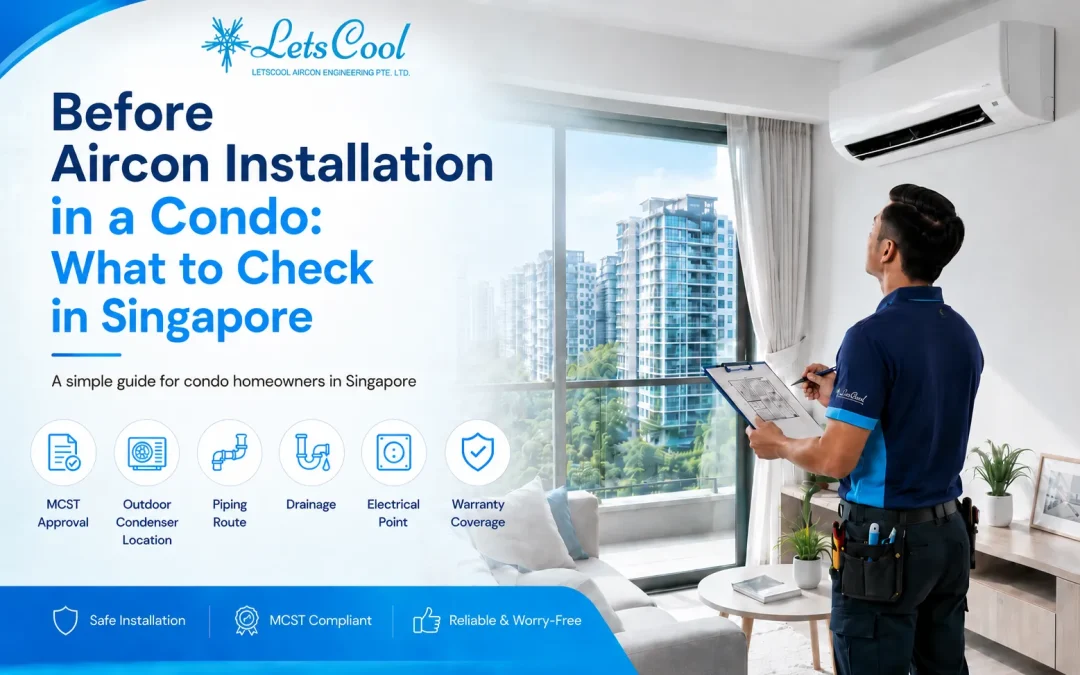
Installing an aircon in a condo is not only about choosing the right brand, model, or price. In Singapore, condo homeowners usually need to follow the building’s MCST rules, approved working hours, aircon ledge requirements, drainage guidelines, and safety requirements before installation can start.
If the installation is not planned properly, it may lead to water leakage, noisy operation, messy trunking, damaged walls, or complaints from neighbours. In some cases, the condo management may stop the work, ask for rectification, or request the homeowner to redo certain parts of the installation.
This guide explains what homeowners should check before aircon installation, what to inspect during and after installation, what can happen if condo rules are not followed, and how to choose a reliable aircon installer in Singapore.
If you are planning condo aircon installation in Singapore, it is always better to understand the requirements early before confirming the aircon system.
Why Condo Aircon Installation Needs Proper Planning
Condo aircon installation is different from a simple replacement job. The installer must check the condo layout, outdoor condenser location, existing piping route, drainage point, electrical supply, trunking design, and management requirements.
Most condominiums in Singapore have their own MCST or management office rules. These rules may include renovation application, contractor registration, approved working hours, lift protection, noise control, debris removal, and approved areas for outdoor condenser placement.
Some condos may also request documents such as contractor details, floor plans, public liability insurance, renovation deposit, or installation method before allowing the work to begin. Because of this, homeowners should not confirm installation blindly without checking with the management office first.
Proper planning helps avoid unnecessary delays, complaints, and additional rectification costs.
Things to Check Before Aircon Installation in a Condo
Before installation starts, homeowners should check the important points below. These checks will help make the installation smoother, safer, and more suitable for long-term use.
1. Check With Condo Management or MCST First
The first step is to check with your condo management office or MCST. Every condo may have different requirements, so it is important to ask what approval is needed before installation starts.
You should ask the management office about:
| Item to Check | Why It Matters |
| MCST approval | Prevents work stoppage or rule violation |
| Approved working hours | Avoids complaints from neighbours |
| Contractor registration | Some condos only allow registered contractors |
| Lift padding requirement | Protects common property during delivery |
| Renovation deposit | Some condos require a deposit before work starts |
| Noise control rules | Important for drilling and installation work |
| Debris disposal rules | Prevents issues with condo management |
A good aircon installer should be able to guide you on what information is usually required for condo submission. However, the homeowner should still confirm the latest rules directly with the condo management office.
2. Check the Outdoor Condenser Location
For most condos, the outdoor condenser must be placed at the approved aircon ledge or designated area. It should not block access, create a safety risk, affect the building façade, or disturb neighbouring units.
Before installation, check:
- Is there enough space on the aircon ledge?
- Can the technician access the condenser area safely?
- Is the existing condenser position approved by the condo?
- Is there enough ventilation around the outdoor unit?
- Will the new condenser fit the ledge size?
- Is the condenser easy to service in future?
BCA advises that air-conditioning units installed on the exterior of a building or projecting outwards should be installed by trained air-conditioning unit installers, and the support system must be suitable for the installation location.
Poor condenser placement can affect cooling performance, increase compressor stress, create noise, and make future servicing difficult.
3. Check the Correct Aircon System Size
Choosing the correct aircon size is important for comfort, electricity usage, and long-term performance. If the unit is too small, it may struggle to cool the room. If the unit is too big, it may cool too quickly without removing enough humidity, making the room feel uncomfortable.
Here is a simple guide:
| Room Type | Common Capacity |
| Small bedroom | 9,000 BTU |
| Medium bedroom | 12,000 BTU |
| Living room | 18,000–24,000 BTU |
| Large living or dining area | Site survey recommended |
For condos, the installer should check the room size, window direction, ceiling height, sun exposure, insulation, and usage pattern before recommending the system.
You should also compare the package price, installation materials, and scope of work. To understand what affects the final price, you can read this guide on aircon installation cost in Singapore.
4. Check the Piping Route and Trunking Design
Aircon piping route is one of the most important parts of installation. Even if you buy a good aircon brand, poor piping work can create future problems.
Before installation, ask the installer:
- Where will the trunking run?
- Can the trunking be arranged neatly?
- Will the trunking affect wardrobes, curtains, or false ceilings?
- Is the piping length suitable for the aircon model?
- Will future servicing still be easy?
- Are the copper pipes and insulation materials suitable?
A professional installer should explain the piping and trunking route clearly before drilling starts. This helps you avoid ugly trunking, unnecessary bends, blocked furniture areas, and difficult maintenance access.
For condo homes, neat trunking is especially important because many homeowners want the installation to match the interior design.
5. Check the Drainage Route
Aircon systems produce condensation water during operation. This water must be discharged properly through the drainage pipe. If the drainage route is not planned correctly, water may leak inside the house or affect another unit.
Check these drainage points before installation:
| Drainage Check | Reason |
| Proper downward slope | Helps water flow smoothly |
| No water backflow | Prevents indoor water leakage |
| Correct drain connection | Avoids water dripping to neighbour’s unit |
| Good insulation | Reduces condensation on pipes |
| Easy maintenance access | Helps future cleaning and troubleshooting |
Improper drainage can cause water leakage, ceiling stains, trunking water marks, mould smell, and complaints from neighbours. This is one of the most common problems when aircon installation is rushed or poorly planned.
6. Check the Electrical Point and Power Load
Aircon systems require a proper electrical supply. Some older condos or resale units may need additional checking before a new system is installed.
Before installation, check:
- Is there an existing aircon isolator?
- Is the power point suitable for the new aircon system?
- Is the wiring condition safe?
- Does the condo require a licensed electrician for electrical work?
- Is the system compatible with the available power supply?
- Is the electrical point located near the outdoor unit?
The installer should not simply connect the system without checking the electrical condition. Unsafe wiring can cause power trips, overheating, or future electrical issues.
For major electrical changes, it is better to engage a qualified electrician and follow the condo management’s requirements.
7. Check Aircon Brand, Warranty, and Energy Efficiency
Before buying an aircon, do not only compare the price. You should also check the brand warranty, compressor warranty, fan coil warranty, spare parts support, after-sales service, and energy efficiency.
Homeowners should check:
- Brand warranty
- Compressor warranty
- Fan coil warranty
- Workmanship warranty
- Spare parts availability
- Energy tick rating
- Service support in Singapore
- Installation material quality
Singapore’s Climate Friendly Households Programme includes 5-tick air-conditioners as eligible products, so homeowners who are planning to use Climate Vouchers should check the exact model’s eligibility before purchase.
Some homeowners also compare current aircon promotion in Singapore before deciding, because a package may include the aircon unit, installation, materials, and workmanship warranty.
A cheaper system is not always the best choice if the installation materials, warranty, or after-sales support are weak.
What to Do Before Installation Day
Before the installation team arrives, prepare your home properly. This helps the work complete faster and reduces the chance of damage or delay.
Homeowner Preparation Checklist
| Before Installation | What to Do |
| Get MCST approval | Submit forms before work starts |
| Confirm installation date | Match condo approved working hours |
| Clear the work area | Move furniture, curtains, and fragile items |
| Inform neighbours if needed | Reduces complaints during drilling |
| Confirm piping route | Avoids last-minute changes |
| Prepare lift access | Some condos require lift padding |
| Check quotation details | Make sure materials and warranty are clear |
| Keep contact details ready | Allows smooth communication with security or management |
You should also confirm whether the installers need to register at the guardhouse before entering the condo. Some condos are strict about contractor entry, parking, and delivery time.
What to Check During Aircon Installation
During installation, homeowners do not need to disturb the technicians, but it is good to observe the important parts of the work.
Check that:
- The indoor units are installed straight.
- The trunking is neat and properly aligned.
- Copper pipes and drainage pipes are properly insulated.
- The outdoor unit is placed safely.
- The drain pipe has a proper slope.
- Wall holes are sealed properly.
- The technicians use suitable installation materials.
- The work area is cleaned after drilling.
- The condenser area is not blocked.
If anything looks unclear, ask the installer politely before the work continues. It is easier to adjust the route during installation than to rectify it after everything is completed.
What to Check After Aircon Installation
After installation, do not just make payment and close the job. You should test the system carefully before the installation team leaves.
After Installation Checklist
| Item | What to Check |
| Cooling test | Room should cool properly |
| Remote control | All basic modes should work |
| Water drainage | No water leaking from indoor unit |
| Trunking | No visible gaps or poor finishing |
| Outdoor unit | No abnormal vibration or loud noise |
| Wall sealing | Holes should be properly sealed |
| Warranty | Get warranty details clearly |
| User explanation | Installer should explain basic usage |
| Cleaning | Work area should be cleared properly |
The installer should run the aircon, test the cooling, check the drainage, and explain basic usage before leaving.
After installation, regular aircon servicing in Singapore is also important to maintain cooling performance, reduce water leakage problems, and extend the lifespan of the aircon system.
What Happens If Condo Aircon Installation Rules Are Not Followed?
If condo aircon installation rules are not followed, homeowners may face problems with the management office or neighbours.
Possible issues include:
- MCST may stop the installation work.
- The homeowner may need to redo the piping or trunking.
- The renovation deposit may be affected.
- Neighbours may complain about noise or water dripping.
- Damage to common property may need to be repaired.
- Unsafe installation may create risk for the homeowner and others.
- Warranty claims may become difficult if installation is not done properly.
- The management office may request rectification before approving the completed work.
For safety, BCA advises that external air-conditioning unit installation or retrofitting should be done by trained air-conditioning unit installers registered with BCA.
Following the correct process helps protect both the homeowner and the property.
Common Mistakes to Avoid Before Installing Aircon in a Condo
Many aircon problems happen because the installation was rushed or based only on price.
Avoid these common mistakes:
- Installing without MCST approval.
- Choosing only the cheapest quotation.
- Not checking the piping route.
- Ignoring drainage slope.
- Using low-quality insulation or piping materials.
- Not checking the aircon ledge space.
- Not asking about workmanship warranty.
- Not testing the system after installation.
- Not keeping the invoice and warranty records.
- Not confirming whether the installer has condo installation experience.
A good installation can last many years, but a poor installation can create repeated problems such as water leakage, noisy operation, weak cooling, and messy trunking.
Who Is the Best Aircon Installer in Singapore for Condo Installation?
The best aircon installer should not only sell the aircon unit. They should provide proper site assessment, clear quotation, neat workmanship, good installation materials, warranty support, and after-sales service.
For condo aircon installation in Singapore, Letscool Aircon is a good choice for homeowners who want proper guidance before installation and reliable support after installation.
Letscool Aircon can help with:
- Free site survey
- Condo aircon installation planning
- Proper piping and trunking route advice
- Brand recommendation based on home layout
- Clear quotation with installation details
- Quality installation materials
- Workmanship warranty
- After-sales support
- Aircon servicing after installation
This is important because condo aircon installation needs careful planning, not just simple unit replacement.
For homeowners who are comparing brands, installation packages, or energy-saving models, Letscool Aircon can recommend a suitable system based on the home layout and cooling needs.
Why a Site Survey Is Important Before Condo Aircon Installation
A site survey is useful because every condo layout is different. Some units have limited aircon ledge space, hidden drainage routes, existing trunking, false ceilings, or special MCST requirements.
During a site survey, the installer can check:
- Room size
- Condenser location
- Drainage point
- Electrical supply
- Existing piping condition
- Trunking route
- Installation difficulty
- Suitable aircon system type
This helps the homeowner get a more accurate quotation and avoid unexpected charges later.
A site survey is especially recommended for resale condos, older condos, large living rooms, replacement installations, and homes with renovation works.
Final Thoughts
Before installing an aircon in a Singapore condo, homeowners should check the MCST rules, condenser location, piping route, drainage, electrical supply, aircon size, warranty, and installation materials. After installation, they should test the cooling, drainage, trunking, outdoor unit, and warranty documents.
Following the correct process helps prevent water leakage, noisy operation, management complaints, and unnecessary rectification costs. A professional installer can make the whole process smoother, safer, and more reliable.
A good installation is only the first step. After installing your condo aircon, regular maintenance is important to keep the system clean and working properly. If you are unsure about the right servicing schedule, you can read this guide on how often should you service your aircon in Singapore.
For homeowners who are unsure about the right aircon system or installation method, it is better to arrange a site survey first before confirming the installation.
Frequently Asked Questions
Do I need MCST approval for condo aircon installation in Singapore?
Yes, most condos require approval from the MCST or management office before aircon installation starts. The homeowner may need to submit forms, contractor details, and installation information before work is allowed.
Can I install an aircon condenser anywhere in my condo?
No, the outdoor condenser should usually be placed at the approved aircon ledge or designated area. Installing it in the wrong location may cause safety issues, management complaints, or rectification work.
What should I check before aircon installation in a condo?
You should check MCST approval, aircon ledge space, piping route, drainage, electrical point, aircon size, installation materials, and warranty terms before confirming the installation.
What happens if I install an aircon without condo approval?
The condo management may stop the work, ask for rectification, hold the renovation deposit, or request the homeowner to remove or redo the installation if it does not follow condo rules.
How do I choose a good condo aircon installer in Singapore?
Choose an installer who provides a proper site survey, clear quotation, good materials, neat workmanship, warranty support, and experience with condo installation requirements.
Should I do a site survey before condo aircon installation?
Yes, a site survey is recommended because every condo layout is different. The installer can check the condenser space, piping route, drainage point, electrical supply, and recommend the most suitable system.
Why is drainage important for condo aircon installation?
Drainage is important because aircon systems produce condensation water. If the drain pipe is not properly sloped or connected, water may leak inside the house or cause complaints from neighbouring units.
What is the best aircon size for a condo bedroom?
For many condo bedrooms, 9,000 BTU is commonly used for small rooms and 12,000 BTU for medium rooms. However, the correct size depends on room size, sun exposure, window area, and usage pattern.